I
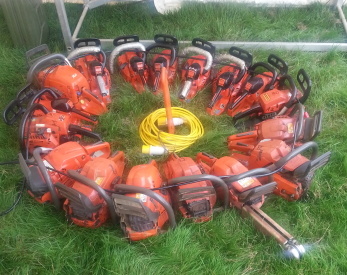
built up this collection over the years, balancing the choice of saw with the
type of job I've had to do. These are the ones still working.
Don't
think you need all of these to be able to start carving - I started out with just
one. I actually only use 4 saws regularly. When working or demonstrating I also
carry a back up saw for each of those four, eight saws so far. Then there is the
monster saw, a 120cc Husqvarna. This saw is used with a 30", 36" or 48" bar for
the serious breaking down of large chunks of timber. That makes 9 saws, which
is a bit of a luxury, but keeps me going. I keep so many saws as I'm called on
occasionally to lend saws out to overseas carvers taking part in UK events.
I
will not recommend any particular make as they all have their ups and downs and
are constantly evolving as the manufacturers update the designs.
The Biggest
Saw
I
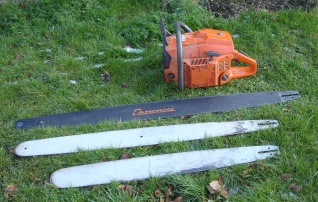
have a Husqvarna 3120 that I bought new in the good old days when a chainsaw could
be easily bought online. It was quite inexpensive as it was old stock. These saws
are invariably professional models due to the very demanding work they have to
be able to cope with. Shown with three different sizes of bar.
This
saw is usually only brought out occasionally as the need to break up very large
timber only arises now and then. Because of this, this particular saw is likely
to last a carver a very long time. Pity that it is also likely to be the most
expensive of saw purchases. For this reason the aspiring carver should really
think carefully about whether or not they really need such a big saw before they
purchase one.
This
size of saw is very heavy, especially with a large guide bar mounted. Anyone of
slight build may find it very dangerous to handle, and possibly impossible to
start as (even with the de-compression button) it takes a lot of fast tugging
on the starter cord to get it going. Tearing forearm tendons due to starter cord
snatchback is not unheard of. With the larger bars, the sharpening of the saw
chain can take quite a while if doing it by hand. If using a machine, be aware
that the teeth on the chain can become case hardened due to the heat from the
high speed grinding. It then becomes impossible to sharpen by hand in the future
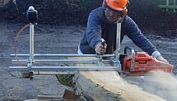
as it completely dulls the file. This saw is ideal for use with one of the chainsaw
milling attachments such as the Alaskan
Mill.
.
Medium
Saws
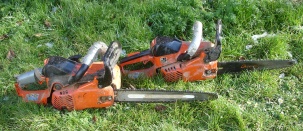
The
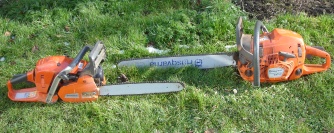
smaller of the two is the saw that is worked the hardest of all the saws. It is
a 55cc saw with a 16" bar running semi-chisel chain. As it is the saw carrying
out the bulk of the work it should definately be a professional model. As much
of the carving work as possible should be carried out with this saw before picking
up a small carving saw. Time and excess wear and tear on the smaller saws will
be saved by working this way. Depending on the make of saw, it can often be fitted
with non standard bar and chain combinations for more specialised use.
The
larger saw should be in the 65-70cc range at least, to be able to drive a 24"
bar and chain setup. This is the saw most used for general blocking out and ripping
up logs into boards. In this size range most saws that are available are professional
models. I find that it is most useful to me to run a full chisel chain on this
setup. It copes well with the harder timbers.
For
those of a lighter build in particular, there is a clear advantage in having a
de-compression button on these saws. Makes for a lot less stress and strain in
starting them.
Small
Saws
One
of around 35cc equipped with a 16" carving bar. This is used for accessing deeper
areas in carvings as well as fine roughing out and general carving. Quarter inch
pitch chain works best on this.
The
other saw can be of a similar power output, or a little less, as it is running
a 12" carving bar with the quarter inch pitch chain. This is the saw used for
all the finer detail work. The smallest carving bar available is 8" which could
be fitted to this saw instead of the 12" if it is required for particularly fiddly
detail work.
Electric
Saw
An
electric saw is useful for indoor work. However, they generally lack the power
and chain speed of a petrol saw. If it is to be used with a generator then pick
a generator of at least 3500w upwards. Saws with the motors in-line are better
than those where it sticks straight out the side. Normally these saws also come
with "consumer" chain fitted. This will
limit the saws ability to plunge cut so is best swapped for "professional" chain.
Apart
from all of the above, remember to watch out that all of the safety features as
detailed on the Chainsaw Safety Features page are in place. Avoid using guide
bars that are very wide across the side face, these bars have comparatively large
kickback area at the nose. Avoid using "top handled saws" as there is insufficient
control due to the lack of compensatory leverage afforded by the rear handled
saws. They also strain your wrist a lot.