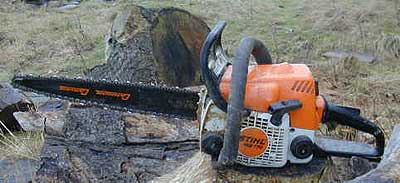
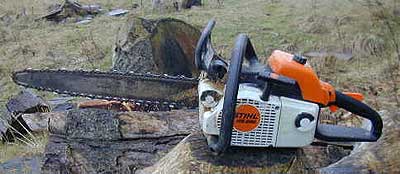
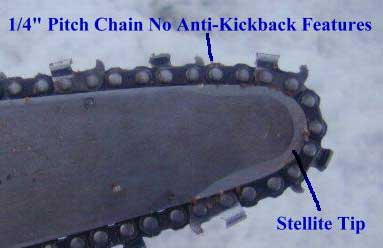
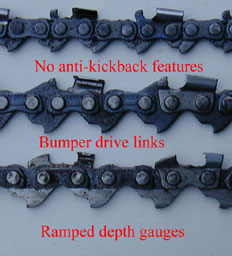
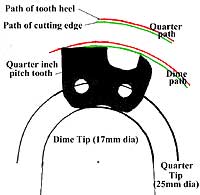
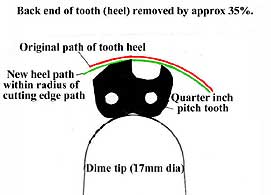
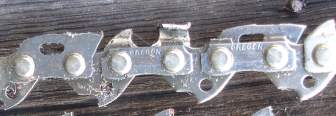
.Below is a close up of the
tip of my 16" carving bar, it has a radius of about 12mm (quarter tip). The 12"
bar has a radius of about 8mm (dime tip). These bars are made in Canada and are
very well engineered. They are made from one piece of steel (rather than being
laminated), the rails are triple induction hardened and the tip has a sizable
section of stellite welded into it (as can be seen in the photo). They are solid
nose bars and the gauge of the bar groove is 0.050". When first put to use it
is advisable to run the chain relatively slack (i.e.hanging down with the tie
straps just off the bottom bar rails) compared to the standard tension used with
a solid nose bar. Initially there is a tendency for the bar to heat up a lot while
both bar and chain are bedding in. This causes the chain oil to burn black which
is then thrown off onto the carving making black lines. This normally passes after
a few days of carving, then the chain can be run a little tighter (as a rough
guide the bottom of the tang in the middle of the chain, hanging from the bottom
of the bar, should be nearly visible). The black lines get fewer as the bar and
chain bed in (as long as the saw oiler is working efficiently). The chain should
be very easy to pull round the bar. It does very little harm for the bar tip to
heat up to and turn blue as long as it isn't prolonged. This often occurs in heavy
use.
The carving
bars come in a variety of sizes and normally with three different types of tip.
Smallest is about 8" useable length longest about 24" (there may be other sizes
available from specialist suppliers). The three types of tip are "dime", "quarter"
and "toonie",
Dime
tip. The smallest radius. This is best being reserved for the final fine
detailing work using the shorter bars. They don't hold up well to being used on
overpowered saws or for heavier cutting. The small tip means that there is a lot
of heat and friction built up there in heavy use, this can lead to early wearing
out or stiffening up of the chain. The bar nose can also develop undue wear on
the inside of the rails, even to the extent of the chain forcing the bar rails
apart.
Quarter
tip. Next size up. Where the "dime" compares to the size of the American
coin of that name, the "quarter" compares to the size of that particular coin.
This bar is more suited to a bit heavier work. The larger tip radius means that
there is less concentration of heat as the load of the chain is spread over a
longer length of bar rail. The tip of the bar is still small enough to use without
having to worry overmuch about kickback. Just not quite as good as a dime for
fine detail.
Toonie
tip. Named after a Canadian coin of the same radius, a bit bigger than
the "quarter"tip. This type of bar is a very good substite for a standard sprocket
nosed bar. It has a small enough radius to deliver very little kickback. The fact
that it is a solid bar and has no sprocket means that it will take a lot more
punishment than a sprocket nosed bar. Often used for general roughing out and
even levering off partially cut sections of timber. Chain still has to be run
a little loose compared to a sprocket nose bar. The bar is still .050 gauge so
the chains mostly used on it (3/8 low profile, and 1/4 pitch both .050 gauge)
are just a bit more fragile than the standard .058 and .063 gauge chains normally
fitted to mid range saws. It is not unusual to snap, even a new chain, in hard
timber or when the chain gets nipped in a cut.
Sprocket
tip carving bars. These are made by an Australian company GB
Manufacturing Pty Ltd. They are not very generally available but if one comes
across one of these bars there are a few things to be aware of. The chain has
to run snugly on these bars, not slack as in the usual carving bars. If run slack
there will not be enough oil getting to the sprocket nose and it will fail. There
is noticeable kickback with these bars, not dangerous, but annoying. It can jump
in a cut causing damage to surrounding areas. It is also very fragile, the sprocket
is very small and won't take a lot of heavy cutting. The company make an excellent
range of other bars (including carving bars) as well.